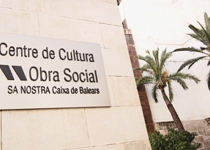
The Obra Social Sa Nostra Caixa de Balears and BMN launches a new edition of the courses for adults of the 2018-2019 season, which are held at the Centre de Cultura Sa Nostra in Palma. The courses of History of Art and Historical-Artistic Heritage are taught by María José Lapeña and are held from October 22, 2018 to May 31, 2019.
History of art and historical-artistic heritage
Primero historia del arte
Teacher: María José Lapeña.
Schedule: Monday and Wednesday from 11 am to 12 noon.
Ancient art: Prehistoric art. The Neolithic. Bronze age and the Balearic culture. Art of ancient civilizations: Mesopotamia and Egypt.
Classical art: Origins of Greek art: Crete and Mycenae. Ancient Greece: The polis, the temple and mythology. Ancient Rome: Etruscan art. The civil and religious architecture. Romanization and its impact on our geography. First art of Christianity.
Medieval art: From the Byzantine Empire to the Europe of the cathedrals. Byzantine art: Santa Sophia. Islam: The mosque. The Hispanic Muslim art. Feudal Europe: Romanesque and its spiritual importance. The pilgrimage routes (the Camino de Santiago). Gothic art and the urban phenomenon.
Segundo historia del arte
Teacher: María José Lapeña.
Schedule: Monday and Wednesday from 12 noon to 1pm.
The international Gothic of Flanders: Times of princes and kings who loved art. The flemish painting. The art of the Catholic Kings.
The Italian Trecento and Quattrocento: The return to humanism and classicism; Petrarch. The first Renaissance in Florence. The Court of the Medici: Lorenzo the Magnificent
Century XVI: Power and splendor of the papal courts. Time of the great geniuses: Leonardo, Rafael and Miguel Ángel. Felipe II and the Escorial.
Baroque art: Caravaggio, Rubens, Rembrandt. Baroque architecture and sculpture in Spain: Castilian and Andalusian images. Spanish painting: José Ribera, Velázquez, Murillo, Zurbarán. The Baroque in Mallorca.
Tercero historia del arte
Teacher: María José Lapeña.
Hours: Tuesday and Thursday from 11 am to 12 pm.
Rococo in France and its diffusion in Europe: The eighteenth century in France, the absolutism of Louis XV. Importance of the Company of the Indies. Assimilation of oriental art and its diffusion in Europe.
Neoclassicism: Greece as a source of artistic inspiration. The discovery of Pompeii and Herculaneum. French Revolution of 1789 and revolutionary art. Spain: The reforms of Carlos III. Juan de Villanueva and the new architecture. Francisco de Goya. Neoclassicism in Palma; a new concept of city.
Romanticism: New models and materials in architecture: the neo-Gothic. Urban renewal in cities; Orientalism, historicism and exaltation of emotions. Realism and impressionism. The industrial revolution in Europe. School of Barbizon and the birth of landscaping. England: Turner and Constable.
Impressionism: Monet. Spain; Sorolla Post-impressionism: Gauguin, Van Gogh, Cézanne, etc. Symbolism and modernism. Antecedents of the symbolism: the prerrafaelitas. Influence of literature on symbolist painting. Modernism in Europe and in our environment.
Cuarto historia del arte
Teacher: María José Lapeña.
Schedule: Tuesday and Thursday from 12 noon to 1pm.
Art of the twentieth century: artistic background of the twentieth century. Avant-garde concept and birth of the first "isms". Fauvism and German Expressionism. First geometry and abstraction, Cubism, Futurism, Orphism, Constructivism and Neoplasticism. Metaphysical painting, Dadaism and Naïf. Surrealism; Miró, Dalí Painting after World War II; Abstract Expressionism, Pop Art, Conceptual Art and Minimalism. Sculpture and evolution of architecture. Specificity in Spain and Mallorca; Civil war.
The topics will be studied first in general and then referred specifically to Mallorca. The theoretical classes will be complemented with slides and audiovisual material. In addition, concerted visits will be made to different monuments and museums of Mallorca.
Sa Nostra BMN customer price: € 90
Non-customers price: € 135
The deadline to formalize registration is from October 1 to 5 at the Sa Nostra Culture Center from 11:00 to 14:00 h.
It is necessary to present the completed registration form at the time of registration. Payment must be made with your bank card.
The courses will be given as long as there is a minimum number of students.
Telephone information:
971 59 59 80 (from 11 am to 2 pm)